
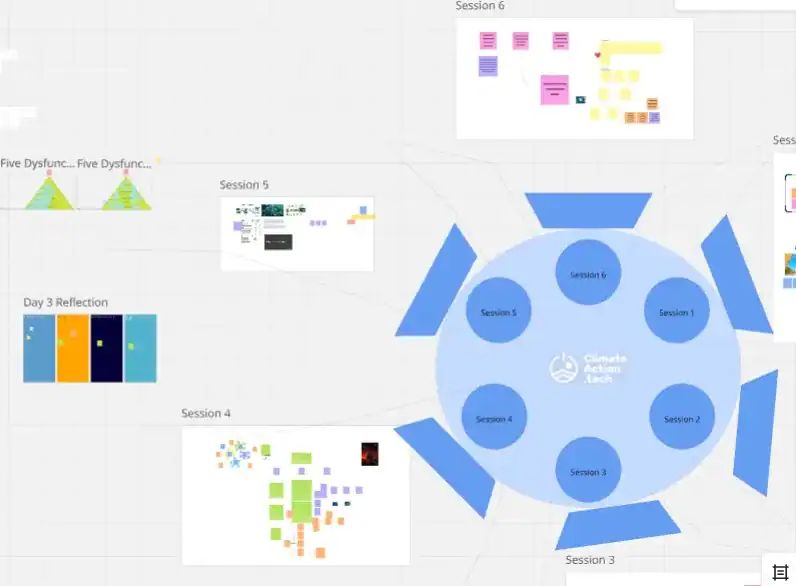
On May 13, 2026, five ClimateAction.Tech (CAT) members convened to begin a six-session journey of co-creation and learning. Facilitated by Jon Sleeper, this coaching circle brought together individuals working within private and public sector organizations. They all shared a focus on influencing the carbon impact of computing within their respective environments, whether through direct work, contracts, or consulting. The participants, Mark Buss, Josh Clark, Siddhesh Wagle, alongside Jon, identified strategies for meaningful change.This article summarizes the key outcomes of those six sessions.
In the previous post about the ClimateAction.tech’s Coaching Circles, we shared how we collaborated to identify an initial priority for the circle. In this blog post, we will walk through how we focused on developing business cases and made a commitment to climate action.
3rd Session: Focusing on Business Cases
We started the third session by checking in on our emotions and what we had learnt so far. This allowed us to explore what more we wanted from the sessions and what we could do differently. Despite our busy schedules and being overwhelmed by the current climate change reality, we wanted to dedicate time to this circle and to have a quantified output as a group.
Reflecting on questions like “How do we define what is wasteful?” and “How do we communicate sustainability for effective change?”, a common theme emerged: the need for a compelling business use case. Leveraging Mark’s existing work on a carbon reduction business case and Josh’s intention to present one to his leadership, we decided to focus on co-creating a business case for Josh’s project over the next three sessions.
Jon shared his “Epic Hypothesis” template as a framework for building such cases. It provided insights into the diverse approaches available for developing business cases. As we worked, a consistent thread emerged. To gain buy-in from leadership, the solutions had to do three things in parallel. As well as reducing emissions, you need a compelling case that the suggestions will also reduce costs as well as enhancing organizational brand value.
We also reflected on identifying the wider stakeholder community within an organization and asking the question, “What’s in it for them?” This can yield additional angles to consider when strengthening the business case. Finally, we discussed examining the organization’s underlying vision and values to identify potential overlaps that could also be referenced.
4th Session: Committing to Action
“To be truly radical is to make hope possible, rather than despair convincing.”
– Raymond Williams
Session 4 began with reflection on the following questions:
- What changes are you experiencing?
- How are you approaching this session?
- What is your primary focus right now?
- How can you support the group?
We collectively expressed a commitment to the exercise and a desire for tangible outcomes. We continued to work on Josh’s business cases, focusing on:
- Standardizing TLS 1.3: Migrating from inconsistent versions of Transport Layer Security (TLS) to standardize on TLS 1.3 across the enterprise. This aims to normalize performance and reduce CPU utilization across our server fleet.
- Redeploying Splunk Forwarders as DaemonSets: Shifting Splunk forwarder deployments from sidecar configurations in Kubernetes to DaemonSets. This will reduce compute resource consumption and associated carbon footprint.
For both use cases, we addressed the following questions:
- How will we identify relevant metrics?
- How will we measure those metrics?
Our discussion expanded beyond carbon reduction to encompass cost savings and engagement with ESG teams. Mark shared his experience and provided a data center emissions data Google Sheet template. We also explored creating impact objectives to avoid focusing solely on carbon reduction.
The following impact objectives were identified:
- Reduced memory footprint (saved space)
- Time savings
- Reduced electricity consumption (saved electricity)
- Decreased future deployment failures
- Reduced emissions
5th Session: Embracing Green Software Principles
The fifth session focused on applying Green Software principles and the SCI (Software Carbon Intensity) formula to Josh’s business case. We also explored several epics (An epic in Agile methodology is a work that requires several sprints to complete and gets broken down into smaller user stories. It helps teams organize big goals, plan long-term timelines, and track progress step by step.):
- Can we develop an emissions model that aligns server/VM-level metrics with facility-level data?
- Could this bottom-up emissions model generate green software standard metrics related to energy efficiency, hardware efficiency, and carbon awareness?
- What is the relative impact of different computing elements on the metrics
By the end of this session, various business case template formats had been developed, and Josh was able to construct a compelling case for one of his identified problem statements.
6th Session: Reviewing and Looking Ahead
The final session involved reviewing the sample business case created by Josh and planning a presentation and blog post for CAT to share our learnings publicly. We also reflected on our collective journey and the value of the circle.
As participants from diverse backgrounds, at varying stages of our climate initiatives, we shared a sense of renewed confidence in the importance of our work and the power of collaborative learning. The circle provided a safe space for us to explore ideas and unlock our collective potential.
We discussed the interplay between micro-level (individual business cases) and macro-level (systemic change throughout the organization) approaches to building sustainable solutions. We also spoke about taking a digital product approach to this going forward to help connect the macro and the micro. We concluded with a sense of hope for achieving meaningful change within our organizations and for our clients.
We encourage the members of the CAT community to consider joining future coaching circles, announcements will be shared soon based on expressed interest. If you are not already a member of ClimateAction.tech, please consider joining our Slack for regular updates and to connect with the community in building ethical and sustainable technology.
Edited by: Andy Davies and Stephanie Haley