
The third edition of ClimateAction.tech’s annual Zurich hackathon took place on Friday May 8th, this year as an official partner event of the first ever Climate Week Zurich! The day was full of motivation, inspiration and caffeination. Over 30 engaged technologists came together to hack on four challenges designed in partnership with Climate Week Zurich partners: ecoinvent, City of Zurich, and Helbling.
The event was organized by long-term CATs Fiona Leibundgut and Andrew Mossop, with support from Alan Solomon and Oleg Lavrovsky and hosted at the Impact Hub Zurich.
About the Event
The hackathon took place on the last day of Climate Week Zurich, one of three hackathons planned throughout the week. The focus was on finding solutions with a positive impact, while also understanding the footprint – full lifecycle.

Following some Kaffi & Gipfeli, the day kicked off with a short scene-setting from Fiona: Why Green Tech, Why Now?
In 2024, the digital sector made up 12% of all Swiss electricity consumption and 2% of greenhouse gas emissions. The hackathon aimed to challenge participants to keep the footprint in mind while hacking new digital solutions in their teams.
Source: Resilio Study, Environmental impacts of the digital sector in Switzerland

The teams then split into their challenge groups to get introduced and start brainstorming. We aimed to create groups of people with different experience levels across students, start-ups, corporates and public sector. With a bit of calibration at the start of the day, everyone found their spot in a challenge that was interesting to them.
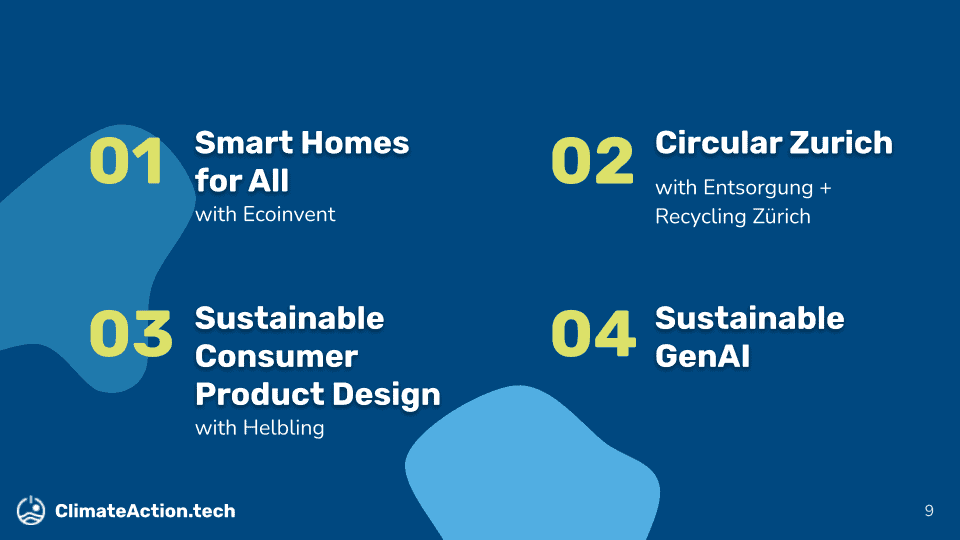
01 – Smart Homes for All
With data from Ecoinvent
How might we design a digital tool that helps homeowners or installers quickly visualize the carbon ‘break-even’ point of a smart home installation?
The Challenge
The smart home market is booming, driven by the promise of convenience, security, and energy efficiency. Homeowners and installers are increasingly adopting IoT devices like smart thermostats, automated lighting, and energy monitors to reduce their energy bills and environmental footprint. However, every smart device comes with its own “carbon debt”—the emissions generated during raw material extraction, manufacturing, and global shipping. Currently, the ecosystem is focused primarily on operational efficiency (saving electricity today) while often ignoring embodied carbon (the environmental cost of the hardware).
The Pitches
Smart Green Key: Your home is one of the biggest levers for cutting costs and carbon. Most people never pull it because nobody shows them where to start. Smart Green Key changes that with clear practical recommendations, in CHF and kg CO2.

Regenerative Communities: A data-driven simulator showing how Swiss households reduce CO₂ through smart technology — and proving, with real numbers, why community coordination always outperforms individual action.

02 – Circular Zurich
With Entsorgung + Recycling Zürich (the waste management organisation of the City of Zurich)
How might we design a scalable, user-centric digital solution that connects, amplifies, and simplifies access to existing circular economy services in Zurich?
The Challenge
Zurich has a fragmented ecosystem of initiatives that promote circular economy practices, ranging from second-hand marketplaces and sharing platforms to repair services and donation networks. These services exist across multiple physical and digital touchpoints, including mobile apps, websites, messaging groups, and community-driven platforms. Despite their diversity and potential impact, most of these solutions operate in silos and remain largely unknown to the broader population.
The Pitches
Züri Kreis: A user-centric digital gateway for repair, reuse, sharing and recycling.

Super Zü-Re: Improving the city’s AI assistant from information to engagement through guidance. Right now Zü-Re informs, with some improvements it activates.

03 – Sustainable Consumer Product Design
With Helbling
Design a consumer product vision for the year 2040 that combines market success with a radically reduced environmental footprint.
The Challenge
Consumer products such as coffee machines, kitchen appliances, or small household devices are often designed for short lifecycles. Driven by cost pressure and fast-changing trends, many of these products are built with limited durability, low repairability, and materials that are difficult to recycle. As a result, they are frequently discarded after a relatively short period of use, contributing significantly to waste and CO₂ emissions. At the same time, affordable and convenient products remain highly attractive to consumers. This creates a key challenge: how to reconcile sustainability, durability, and circularity with cost and user expectations.
The Pitch
The new era of single-serving capsule coffee: Versatile, environmentally-friendly beverage platform to support a sustainable lifestyle and evolving consumer tastes.

04 – Sustainable GenAI
Use Generative AI to solve an environmental problem, and measure the impact of your solution.
The Challenge
Generative AI has shifted from a niche technical field to a foundational tool for global industry in record time. However, this revolution comes with a significant environmental cost: the energy required to serve model queries (inference) and the water cooling needed for data centers are substantial. At the same time, GenAI offers unprecedented capabilities in processing complex climate data, optimizing supply chains, and communicating sustainability concepts to the public.
The industry is at a crossroads: we must find ways to make AI itself “greener” while simultaneously leveraging its power to solve the planet’s most urgent ecological crises.
The Pitches
GenAI Impact Layer: Behaviour change through visibility, make every prompt impact visible, make every choice smarter.

Simplon.off: a friendly little guide. Tell us what you’d like to do and we’ll suggest the smallest local AI model that still does the job – no subscription, no data center, no tracking. When you’re done, you can simply switch it off.

We closed the day with a few drinks and a chance to exchange and network with the other teams, relaxing after an intense day!

Voices from the hackathon
“An incredibly energizing experience. A full day of creativity, problem‑solving, and purpose: all focused on how technology can meaningfully reduce our environmental footprint.” – GenAI Team Member
“Great Event with a nice outcome!” – Helbling Coaches
“The highlight (of Climate Week)”. – Smart Homes Team Member
“I’m excited to join again this year! Excited for tomorrow: new challenges, new perspectives and hopefully many practical ideas for greener tech and more sustainable AI.” – Gen AI Team Member
Lessons learned by the organizers
We again learned a lot from organizing this third edition. Some of our key takeaways this year were:
- it gets easier every year
- start organizing early: we first met in January and had challenges ready by March, for a hackathon happening in May.
- pay attention to your communication: communicate often, be concise and precise.
- engage with the participants early-on and get their firm commitment: this avoids no-shows and helps with budgeting and logistics
- get as many logistic tasks (in particular team matching) done before the event: we only had one day for hacking, so help participants hit the ground running.
We also have a whole library of resources and templates. Furthermore, for this edition, we used a tool called Dribdat to present the challenges and record the teams’ progress: https://climateaction.dribdat.cc/event/3.
Find out more about past CAT Hackathons in Zurich:
If you want to organize your own hackathon and need help or inspiration, feel free to reach out to Fiona Leibundgut or Andrew Mossop on Slack. To find out about any future events, follow Zurich Hackathon on LinkedIn. You can of course also re-use the challenges: they are all linked above. Let’s keep building Green IT!