
Mapping the current reality of unsustainable tech is a complex undertaking. We hold that approaching this challenge allows us to move beyond feeling overwhelmed and instead approach it with empathy. Driven by this belief, we have launched our 12-Part exploration of unsustainable tech where we’ll be co-creating systems maps of our current tech landscape, exploring innovative interventions, and building a collective vision for a sustainable future. Read more about the series here: Mapping the reality of Unsustainable Tech.
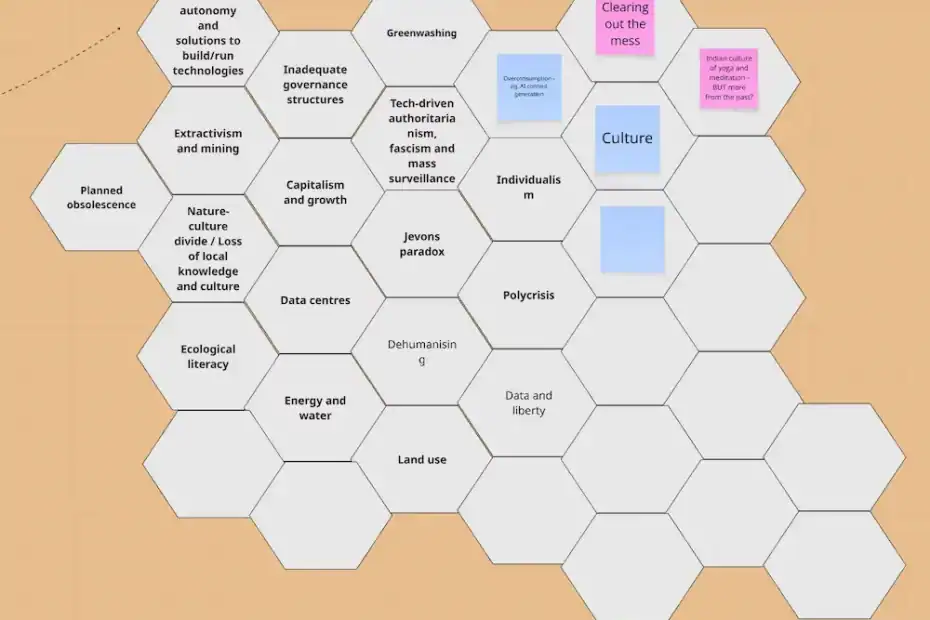
In our first workshop, “Beyond the Buzz: Mapping the root causes of tech’s unsustainability”, CATs gathered to discuss bees and co-create a systems map of the current tech industry. We defined the categories that contribute to this unsustainable nature. The initial idea was to just build 12 categories, but as with any systems thinking workshop, the workshop evolved into something bigger and more beautiful.
The Buzz Continues
The journey continued with our second workshop. A few new participants joined us this time as we dove deep into the “hive” we built during our first workshop.
We started by challenging ourselves: How do we go beyond merely listing categories? We needed to understand the root causes of our shared challenge.
The Deep Dive: Finding the Root Causes
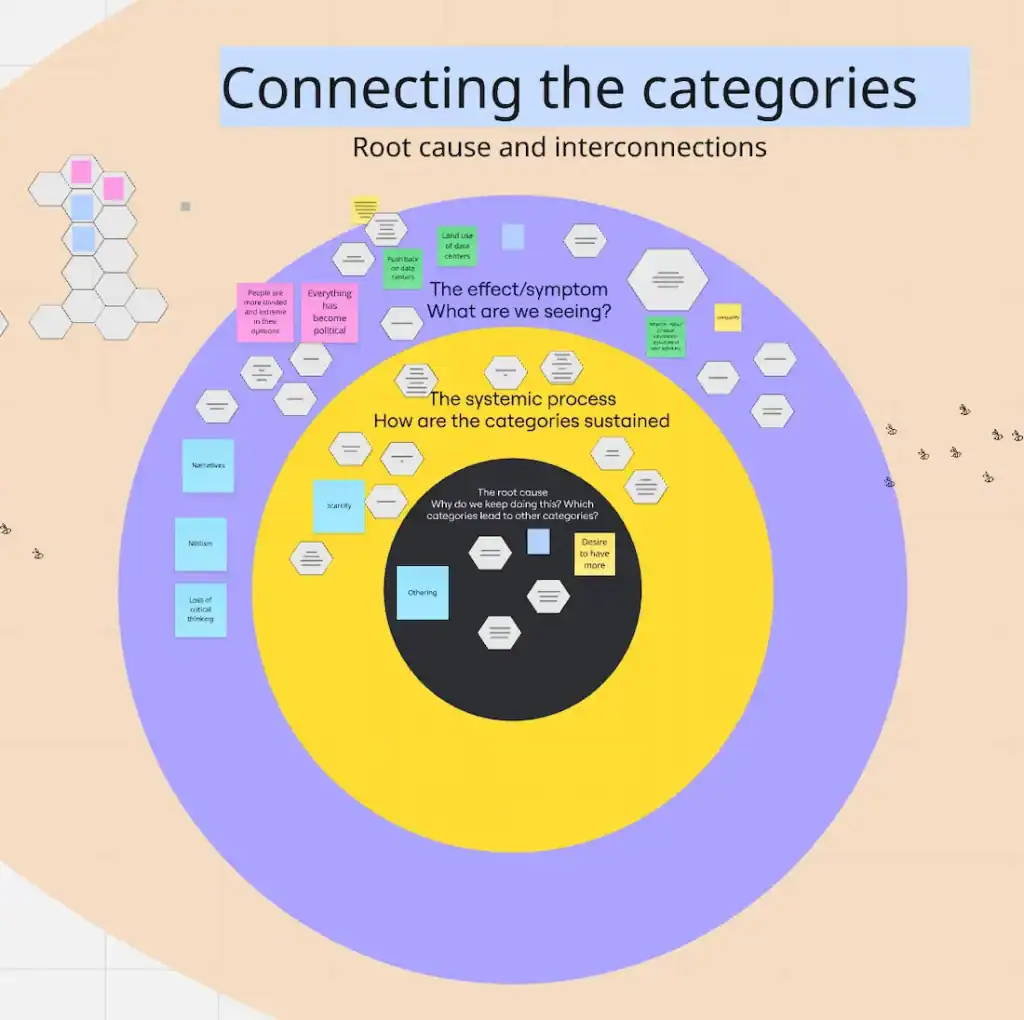
To unpack the complexity, we used a three-ring model to push past symptoms and reach the root causes.
The Symptom (What we see): This ring captured our immediate observations: mass surveillance, planned obsolescence, and mental health strains like apathy or nihilism.
The Systemic process (How it sustains itself): We found the sustaining forces: wealth imbalance (not just monetary, but of data and IP), scarcity mindset, the fragility of our relationship with nature, and the dominance of individualism.
The Root Cause (Why it persists): Finally, the deepest layer revealed the true culprits: the unchecked demands of endless capitalistic growth, a tendency toward “othering,” and inadequate governance structures that allow the problem to sustain.
The Big Picture: Understanding Complexity (Cynefin)
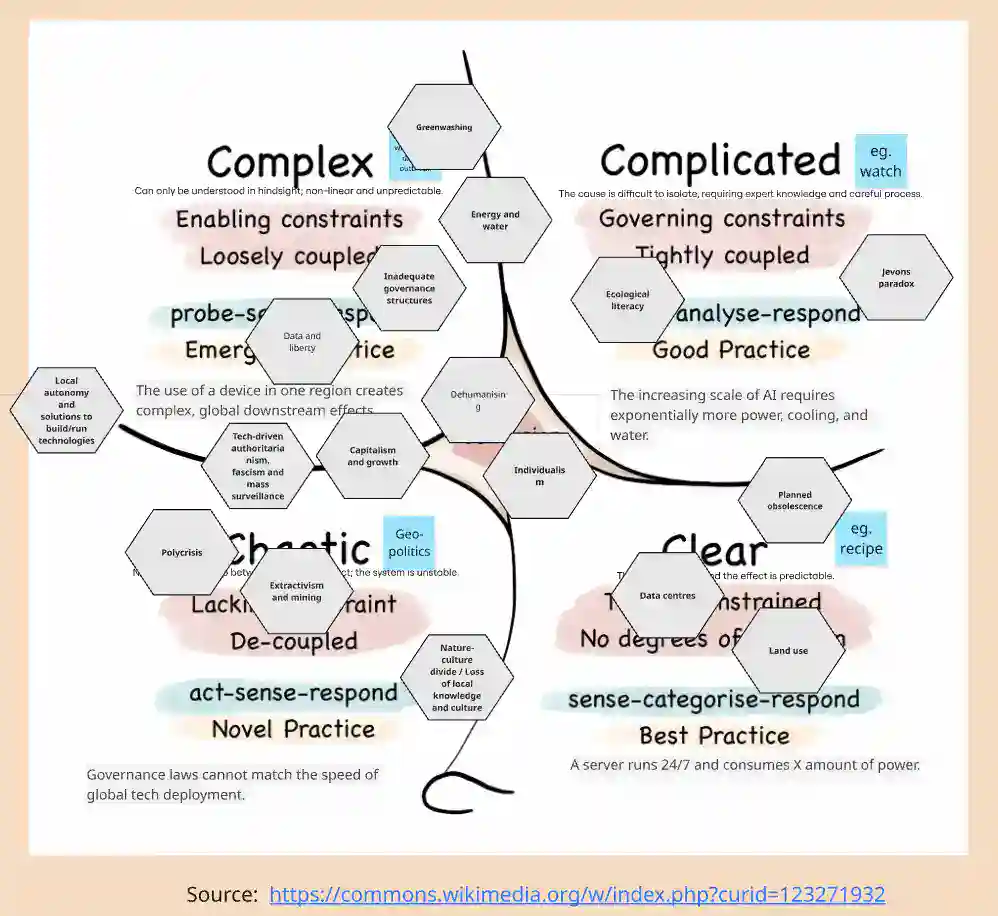

We tackled these connected issues by applying the Cynefin framework, a model for navigating different aspects of complexity. Dave Snowden’s framework reflects his experience in System’s thinking. This framework is different to the usual ‘consultancy’ approach to solving complex problems. You know the type, the suited powerpoint guy thinking that he can come into your organisation with his pre-defined ideas without any understanding of context and point you to a model that gets you into the top right quadrant. This model is about relationships and blurred lines between ‘domains’ or decision-making contexts. The idea is to raise awareness for people in their context to understand where they are in a given situation. This is to help them make better decisions. It is a sense-making device. By applying this approach in our workshop we set about moving what we see into the most appropriate Cynefin domain. This process brought to light that most of our sustainability issues fell within the ‘complex’ domain. Therefore we must move beyond surface fixes and apply systems thinking to uncover the systemic root causes.
While most issues mapped clearly into the ‘complex’ domain, certain categories demanded clear placement. We situated issues such as ‘Local autonomy and solutions to build/run technologies’, ‘tech-driven authoritarianism, fascism, and mass surveillance’, and ‘capitalism and growth’ on the boundary of complex and chaotic. However, we placed ‘Dehumanism’ and ‘Individualism’ in the ‘Disorder’ because it was difficult to pin down their causality.
The map thus reveals the depth of our current crisis. The categories do not exist in isolation; rather, they accelerate into destructive feedback loops, confirming that only systemic solutions can curtail this accelerating crisis of unsustainability, the central focus of our upcoming workshops.
Applying systems thinking tools to map the current reality of unsustainable tech
The initial workshops established the critical categories for our systems map of unsustainable technology. This blueprint provides the structural framework upon which we build. Our next session will apply systems thinking tools to deepen our understanding of why these categories exist. To participate, please RSVP via Luma. For any further details about the series, please contact Siddhesh Wagle.
References
Edited by: Nanda Padmanabhan, Andy Davies, Sandra Pallier
Acknowledgements: A special thank you to Jon Sleeper for generously agreeing to co-facilitating and and introducing the Cynefin framework to the systems workshop series.